Carnival in Lleida
Discover the history and traditions of our Carnival

As Mr. Jordi Curcó says in the book “Fets, costumbrs i llegendes” carnival means deprivation of meat, it includes a period of time of great license in customs and of very broad freedom, which coincides with the beginning of the time of Lent.
According to the oldest traditions of Lleida, the popular and representative character of our carnival is the great “Pau-Pí” or king of Carnival, although in the Costumari Català by Joan Amades he tells us about a character who dressed extravagantly called “el Marraco”.
Our historians point out that these festive and debaucherous celebrations were very famous in the year 1877. The best event of the Lleida carnival was the so-called “Rua Major” with the presentation of the “Pau-Pí” which was carried by a series of devils and people were grouped in comparsas and gangs.
Pau Pí is the personification of Carnival in Lleida. A unique character, exclusive to the Lleida carnival.
The origin of this figure must be sought in a character who, after having been to different countries, made a fortune and upon his return to Lleida, and finding the start of the carnival and seeing that the population was not very participatory with the carnival, he on his own took charge of all the expenses incurred and then began to invite people from the population to start the debauchery for an entire week in which it was one of the most memorable and historic carnivals in the city of Lleida.
The beginning of the carnivals in Lleida towards the 70s we find with Jordi Plens, El Pere Yuguero, El Quimet Mateo and Manel Pelay who towards the end of the Franco regime went out in costume around the city but with little participation since they rather came out of hiding. It is worth remembering that this party in the Franco era was prohibited.
But the first carnival with a face and eyes in the city of Lleida dates back to the years 76-77 where this group of carrinclons, together with Fernando Jove, Ramon Cavero and Albert go out dressed up in a bus full of chickens walking around the city of Lleida having a good time. The Municipal Theatre Class had a very important role, people like Marcel.li Borrell, Margarida Troguet, Carme llaràs and Esteve Cuito who had ideas like going out dressed up all over the main street on a tricycle.
Later, Mr. Pere Yuguero joined the festival committee of the Lleida City Council and from that moment on, the carnivals in Lleida are structured and organized in a more formal way with different troupes. The presentation of the carnivals is in charge of the Municipal Theatre Class which often has the collaboration of Esteve Cuito, an actor and cultural promoter from Lleida.
It was in 1991 that the character of Pau Pí was recovered, based on the information provided by the Ateneu Popular extracted from the costume of Joan Amades, a similar costume and characterization was made.
This presentation in society of this character was made at the Casal de la Joventut Republicana with a kind of theatrical representation where a group of people appeared dressed in a top hat and all dressed the same and from here we can talk about the origin of the Germandat Pau Pí. The now defunct Guasch store on Carrer Major collaborated on this costume.
During the first years the figure of Pau Pí was always represented by himself, in this case Jordi Plens who was a member of the gathering and a person very linked to the cultural activity of the city of Lleida and who died in 2010.
From this date the Pau Pí Brotherhood became visible in the carnivals of the city of Lleida always accompanying the satirical figure of this carnival king, statutes were created, the headquarters of this entity was located in the historic center, and since then it has not stopped collaborating and participating in the carnivals.
Ermengol's space
Ermengol is a great collaborator of the Germandat d’en Pau-Pí and every year he delights us with one of his humorous drawings of the theme chosen for our float.
Ermengol (Francesc Armengol Tolsà i Badia) is an artist and puppeteer known especially for his long career as a daily contributor to the Lleida press. Characterized by a unique drawing style and an intelligent humor, with an ironic and sharp social and political criticism.
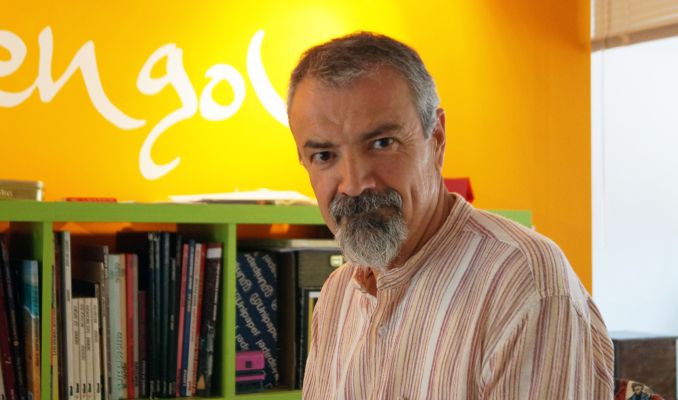
Galeria de Ermengol's space
